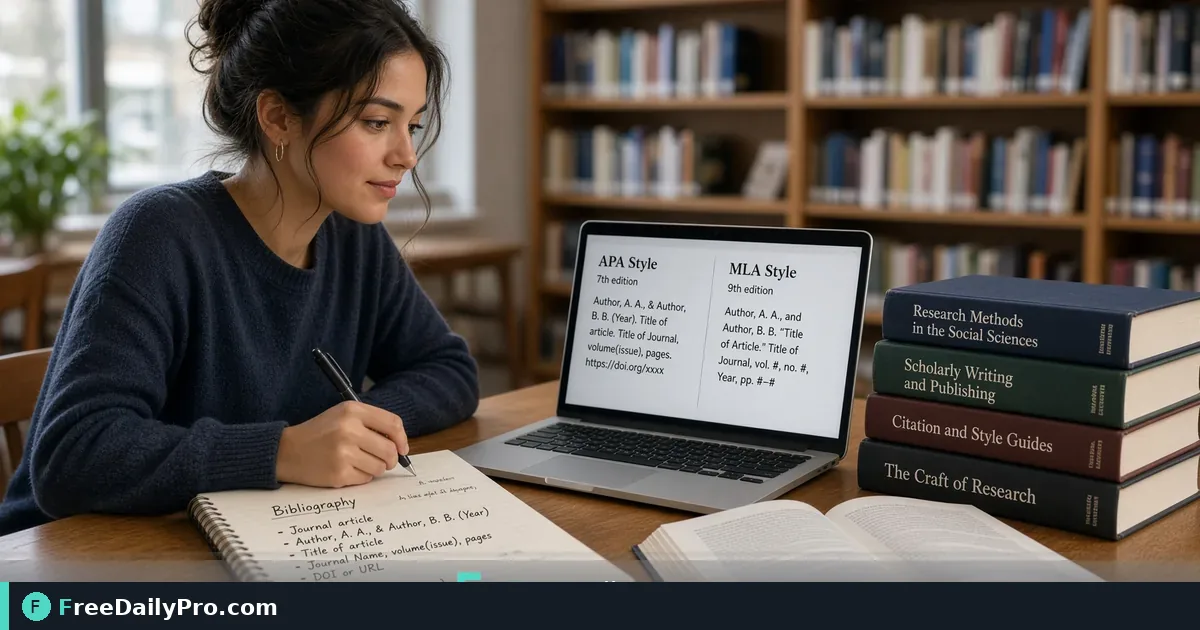
Format APA and MLA Citations Without Guessing the Handbook
Generate APA and MLA citations for papers with a worked example. Check entries against your style guide before submit.
Syllabus says APA 7 or MLA 9. Guessing hanging indents and container titles wastes hours before a deadline. Use a structured generator, then check each line against the handbook example for that source type.

Quick answer
Open Citation Generator. Choose the style your course requires. Enter author, title, year, publisher or URL as the form asks. Copy the entry into your reference list. Count draft length with Word Counter. Polish sentences with Grammar Checker. Check reading level with Reading Level Checker when the assignment sets a grade band. Among 200+ professional tools, citation format is the one step that professors notice first.
Why citations fail at 2 a.m.
Paste from a random website page often misses DOI, retrieval date, or second authors. Generators format what you feed them. Messy input becomes messy output. Official PDFs and publisher pages beat random HTML mirrors. When both exist, prefer the version with a stable DOI.
Numbered workflow
- Read the syllabus for style (APA, MLA) and edition notes.
- List every source you actually cite in the body.
- Open Citation Generator.
- For each source, fill fields carefully: author order, year, title capitalization per style, container (journal name, site name), volume/issue/pages or URL/DOI.
- Paste into your document with hanging indent settings your word processor supports.
- Spot-check three entries against a handbook sample for website, journal article, and book chapter.
- Run body length with Word Counter. Fix grammar with Grammar Checker on the prose, not on the reference list punctuation the style guide owns.
Category: college tools.
Common mistakes
- Mixing APA author-year in text with an MLA Works Cited layout.
- Leaving "n.d." when the page clearly shows a year in the footer.
- Truncating multi-author lists incorrectly for the chosen style.
- Linking citations to pages that moved; add access notes only when the style requires them.
- Polishing citations while the essay still exceeds the word cap—check Word Counter early.
Mini case
A student has eight sources: two journal articles with DOIs, three books, three websites. They generate APA entries one by one, then fix two website titles that were ALL CAPS in the paste. Word Counter shows 1,820 of 2,000 allowed words. Grammar Checker catches a tense shift in the discussion. Submission is clean enough for the grader to focus on argument, not punctuation theater.
What the tool does and does not do
The generator speeds consistent formatting. It does not replace reading the official style manual for edge cases (government docs, court cases, datasets). It does not invent missing authors. If a field is blank, leave it blank rather than inventing a name.
FAQ
Professor wants a different style? Follow the syllabus, not a generator default.
Can I cite a YouTube video? Yes in most styles—use the fields for creator, upload date, and URL as the tool presents them, then verify against the handbook example for audiovisual works.
In-text vs reference list? Generators help the list. In-text citations still need author and year (APA) or author-page (MLA) matching that list exactly.
Honest limits
Trial usage is 10 trial usages a day across FreeDailyPro tools. Large classes should still learn style rules for exams that ban web tools. Always re-open the PDF or page you cited before final lock.
Style guide still wins
If the syllabus says APA 7, do not freestyle Chicago because a sample looked pretty. Generate, then skim every entry against the handbook example for that source type—website versus journal versus book chapter. Professors notice mismatched italics and wrong container titles faster than weak thesis statements sometimes.
Fields people leave blank
Author order matters. Middle initials matter in APA more than students expect. Page ranges for book chapters are not optional when the chapter is what you read. For web pages, capture the date you accessed the material only when your style edition requires it. When a DOI exists, prefer it over a raw search URL that will rot.
Group projects and shared libraries
One student should own the master reference list so formats stay consistent. Others paste their new sources into the same document after generating. Diff the list against the in-text citations before lock: every parenthesis in the body needs a matching entry, and every entry should be cited at least once unless the instructor wants a bibliography of consulted works.
Edge cases worth a second look
Government PDFs, court opinions, and data repositories often need special patterns. The generator helps with common books and articles first. For odd sources, generate a close draft, then edit against the official example. Do not invent an author named "Admin" or "Staff" to fill a blank.
Before you submit checklist
- Style matches syllabus.
- In-text citations match the list.
- DOIs and URLs work when clicked.
- Hanging indents and font match paper template.
- Word count and grammar pass on the essay body using Word Counter and Grammar Checker.
- Reading level fits the assignment if Reading Level Checker is part of your revision habit.
Classroom honesty
Using a citation generator is normal professional practice. Submitting work you did not write is not. Keep generators in the formatting lane. Your analysis still has to be yours. When exams ban devices, you still need to know what a DOI is and how author-year works.
Longer example walkthrough
Say your paper cites a 2021 journal article with three authors, a DOI, and pages 44–61. Enter all three authors in the order printed. Year 2021. Article title in sentence case for APA. Journal title in title case with italics per your editor. Volume, issue, page range, DOI. Generate. Paste. Compare to an APA journal example in the manual. Then cite (First Author et al., 2021) or the full author list in text as your edition requires for three authors. Mismatch between list and in-text is a common deduction.
Tool stack for the whole paper night
Citations first or last is a preference. Many students write, then cite, then panic. Better: add a temporary placeholder citation while drafting, then replace with generated entries in one pass. Keep Citation Generator and the word tools open in separate tabs so you do not lose either.
What success looks like
The grader never comments on format. Feedback focuses on ideas. That is the quiet win of correct references. FreeDailyPro cannot write your paper, but it can remove one class of avoidable errors so you spend energy on argument structure instead of punctuation archaeology.
Next step
Open Citation Generator with one real source from your current draft. Generate, paste, compare to the handbook. Then stack Word Counter and Grammar Checker on the body before you hit submit.
Which citation edge case should FreeDailyPro document next—government reports, datasets, or interview notes? Tell us on contact.