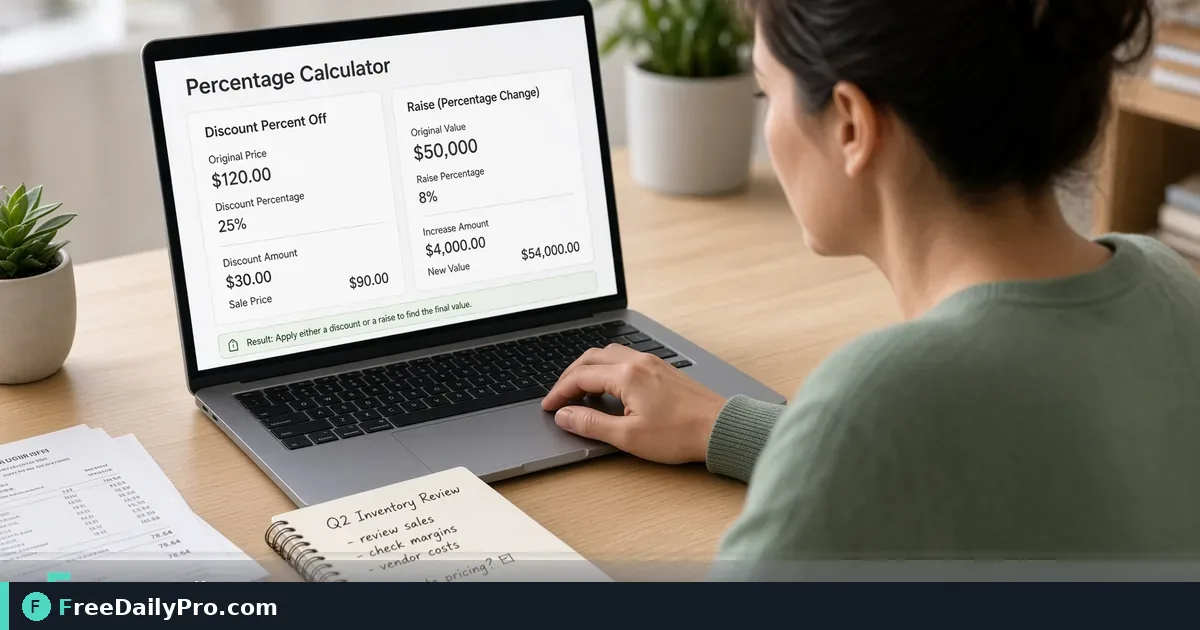
Run Percentage Math You Can Defend in a Meeting
Calculate percentages for discounts, markups, and percent change. Clear steps for business and school math.
"What is 18% of this total?" and "what percent did sales grow?" are different questions. Use a percentage calculator with the right mode, then put the number on an invoice or unit conversion when the workflow needs it.

Quick answer
Open Percentage Calculator. Choose the operation that matches your question (percent of, percent change, increase/decrease). Enter the values shown on the page. For unit swaps around the same project, use Unit Converter. To bill the result, open Invoice Generator. Among 200+ professional tools, percentage math is the one you redo until the story is consistent.
Match the question to the mode
- Percent of: 18% of $240.
- What percent is A of B: 45 is what percent of 200.
- Percent change: from 80 to 100 is a 25% increase. Do not mix "percent of" with "percent change" when reporting to a client.
Numbered workflow
- Write the question in one sentence before touching numbers.
- Open Percentage Calculator.
- Select the matching mode on the live tool.
- Enter base and percent or old and new values carefully.
- Record the result next to the SKU or line item.
- If weight or length is involved, convert units with Unit Converter first so bases match.
- Place priced lines on Invoice Generator when charging a customer.
Category: converters.
Common mistakes
- Applying a discount percent to the wrong base (pre-tax vs post-tax).
- Calling a rise from 10 to 12 a 2% change instead of 20%.
- Stacking two discounts as if they were one combined percent without checking.
- Rounding mid-steps differently than the finance team.
Mini case
A shop offers 15% off a $80 item. Percentage Calculator returns $12 off and $68 due before tax. Owner invoices $68 via Invoice Generator and notes the discount on the line so the customer sees the same math.
FAQ
School vs business? Same math; different labels. Always label the base.
Compound discounts? Calculate sequentially or as your policy defines—do not invent a single percent unless policy says so.
Taxes? Percent calculator can compute tax amounts when you know the rate; confirm local rules separately.
Honest limits
The tool does not know your tax jurisdiction rules. Trial usage is 10 trial usages a day. Double-check high-stakes finance with your accountant when required.
Percent of a total
Retail discount: 20% of 150 is 30 off, 120 remaining before tax. Tip: 18% of the bill after tax or before tax depends on local habit—state your base. Sales commission: 7% of 12,000 is 840. Write the base next to the result every time so later readers know what you meant.
Percent change for growth stories
From 200 units to 250 units is a 25% increase, not a 50 unit percent. From 250 back to 200 is a 20% decrease. Asymmetry surprises people who expect the reverse path to match. Percentage Calculator modes for change keep the formula consistent.
Reverse problems
"45 is what percent of 180?" equals 25%. Students and analysts both miss this when they divide in the wrong order. State the sentence, then pick the mode that matches, then compute.
Markups versus margins
These are not the same. Markup on cost and margin on price use different bases. If your business uses one term in meetings, compute with that definition and label it. Do not switch labels mid-report.
Stacked discounts
Twenty percent off, then an extra ten percent off the reduced price, is not thirty percent off the original unless marketing says so with full clarity. Calculate sequentially if that is the policy. Customers notice when receipts disagree with ads.
School weights
If projects are 40% of the grade and exams 60%, compute weighted pieces carefully. Percentage tools help, but the syllabus owns the weights. Show intermediate steps when teachers require work shown.
Invoicing the result
Once the number is solid, put it on Invoice Generator with a clear line description: "Site audit – 15% package discount applied." Transparency reduces payment disputes.
Units first when needed
If you must compare cost per kilogram and cost per pound, convert units with Unit Converter before percentage comparisons. Mixing unit bases produces confident wrong answers.
Spreadsheet versus quick tool
Spreadsheets are fine for models. A dedicated percentage calculator is faster for one-off meeting math and less error-prone than rebuilding formulas under pressure. Use both where they fit.
Rounding policy
Decide whether to round to cents, whole dollars, or two decimals for rates. Finance teams often have a policy. Apply it the same way every time. Mid-calculation rounding can drift totals.
Worked meeting script
"Last quarter revenue 80, this quarter 92. That is a 15% increase on last quarter as base." Compute live on Percentage Calculator while sharing screen if needed. Confidence comes from the clear base, not from speed alone.
Limits
Currency conversion, tax law, and multi-jurisdiction rules need specialists. The calculator does arithmetic modes. Among 200+ professional tools, it removes arithmetic slips; it does not replace accounting judgment. Trial usage is 10 trial usages a day.
Price tag examples you can reuse
Shelf tag: was 40, now 20 percent off → sale price 32. Bundle: three items totaling 90 with 10 percent off the bundle → 81. Always show was/now when customer-facing so the percent is verifiable. Internal memos should show the formula in one line beside the result.
Audit trail for discounts
Finance may ask how a number was derived months later. Keep a one-line note: date, base amount, percent, tool result, who approved. Screenshot the calculator result when the amount is material. Percentage Calculator is fast; your note makes it defensible.
Next step
Open Percentage Calculator with one real discount or growth figure from this week. Write the sentence you will say in the meeting, then compute. Use Invoice Generator if the number becomes a charge.
What percentage scenario should FreeDailyPro illustrate next—tips, commissions, or grade weights? Send ideas to contact.