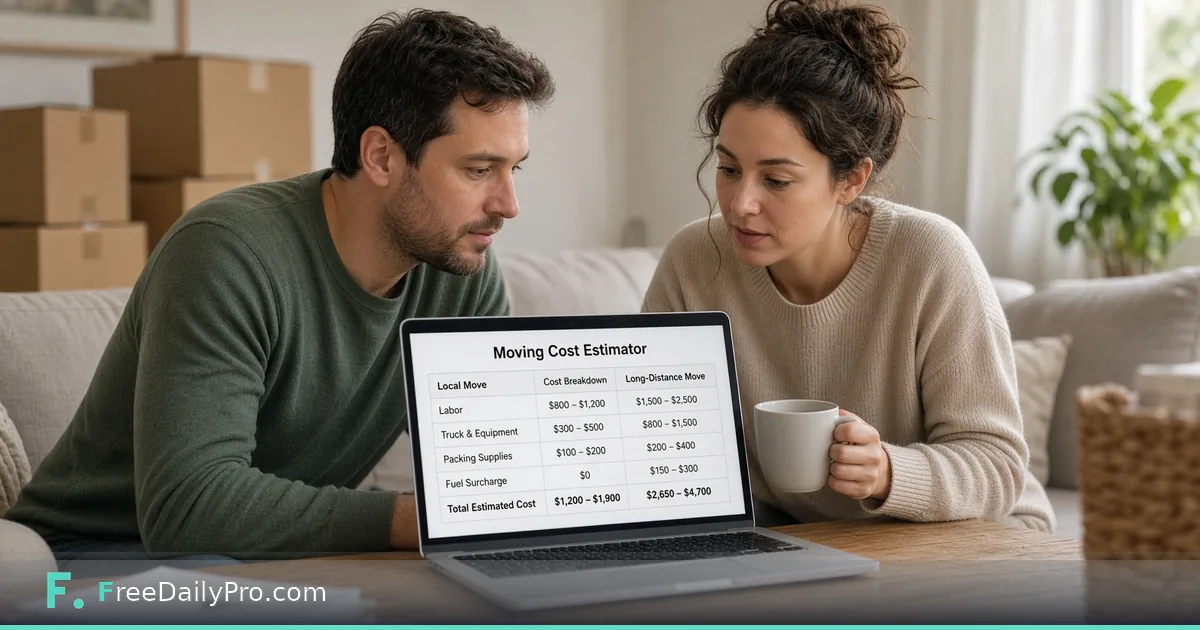
What a Local or Long-Distance Move Might Cost
How the Moving Cost Estimator builds a low-to-high range from home size, distance or crew hours, packing and extras, and why it is not a quote.
You are weighing a lease in another city, and the first question is how much the move itself will cost. Mover websites ask for a call before they give a number. The Moving Cost Estimator gives you a planning range in a minute, so you can decide whether the move fits the budget before you spend an afternoon collecting quotes.
It returns a low and a high figure, not a single price, and it is a budgeting aid rather than a quote. The sections below show how the figure is built so you can judge how far to trust it.

The inputs
Choose a home size from Studio, 1 Bedroom, 2 Bedroom, 3 Bedroom or 4+ Bedroom. Choose Local (same city or metro) or Long-distance. Tick Full packing service if you want it, and type any extra services in dollars, such as storage or a piano. That is the whole form for a long-distance move, plus the distance in miles.
For a local move the form shows four more boxes: number of movers, hours, rate per mover per hour, and a truck or travel fee. They start at typical values for the home size, and every one of them can be changed to match what a mover told you.
How a local estimate is built
Local movers usually charge by the hour for each person on the crew, so the tool multiplies crew by hours by rate and adds the truck fee. The starting rate is $60 per mover per hour and the truck fee starts at $150. A 2 Bedroom starts at 3 movers for 5 hours, which gives 3 x 5 x $60 + $150 = $1,050.
Because the estimate is a range, that midpoint is shown between about $840 and $1,418. If your mover quoted $85 an hour for two people, change the crew and rate boxes and the total follows.
How a long-distance estimate is built
For longer moves the tool starts from a base cost for the home size, then adds the distance. The base is $2,000 for a studio, $3,000 for a 1 Bedroom, $4,500 for a 2 Bedroom, $6,500 for a 3 Bedroom and $9,000 for a 4+ Bedroom. The estimate is 60 percent of that base plus $0.70 for every mile.
For a 2 Bedroom moving 500 miles that is $2,700 plus $350, a midpoint of $3,050 and a range of about $2,440 to $4,118. Add a full packing service, which starts at 15 percent of the base ($675 for this home), and the range for the estimated parts becomes about $2,980 to $5,029.
Why the range leans high
The low end is 80 percent of the midpoint and the high end is 135 percent. The range is deliberately lopsided because real quotes tend to land above a simple formula, not below it. If a move is 1,500 miles or more, the page adds a note that cross-country quotes are priced by shipment weight and often come in above the range. The formula has no weight input, so treat that case as a minimum.
When you type a real quote into the movers box or the packing box, that amount is treated as fixed. The range then applies only to the parts you have not replaced, and a total made only of your own numbers shows as a single figure.
Steps for a useful estimate
- Pick the home size and the move type.
- For a local move, set crew, hours, rate and truck fee from any call you have already had. For long-distance, enter the miles.
- Decide on packing and enter extras separately so they stay out of the range.
- Read the range, then run it again for the other option: movers who only load and drive, against a full-service crew.
- Download the result as an image or press Share to copy it. Downloading the image counts as one of your 10 trial usages for the day; reading the numbers does not.
A local move against a long one
The two modes answer different questions, so do not compare their totals directly. A local estimate is driven by time on the clock, so a crew that works faster or a home with a short carry makes it smaller. A long-distance estimate is driven by home size and miles, so adding a hundred miles adds about $70 at the midpoint whatever the home holds.
If you are choosing between two cities, run the long-distance estimate for each and compare the difference, not the absolute figure. The gap between them is more reliable than either number alone.
Common mistakes
Treating the midpoint as the price. Forgetting fuel, tolls, parking permits, tips, packing supplies and a night in a hotel, none of which are in the form. Ignoring season: the estimate has no month input, and summer and month-end moves usually cost more. Entering miles for a local move, where the tool does not use distance at all.
Turning the range into a plan
Collect at least three quotes, using the estimate as a sanity check. A quote far below the range deserves a question about what it leaves out, such as stairs, long carries or insurance. A quote far above it deserves a request for the line items.
Next, put dates on the work with Relocation Checklist and Timeline, and check whether the new city changes your monthly costs with Cost of Living Comparison. The rest of the group is under relocation tools.
Which part of a move is hardest for you to price: packing, storage or the long haul? Tell us on the contact page.