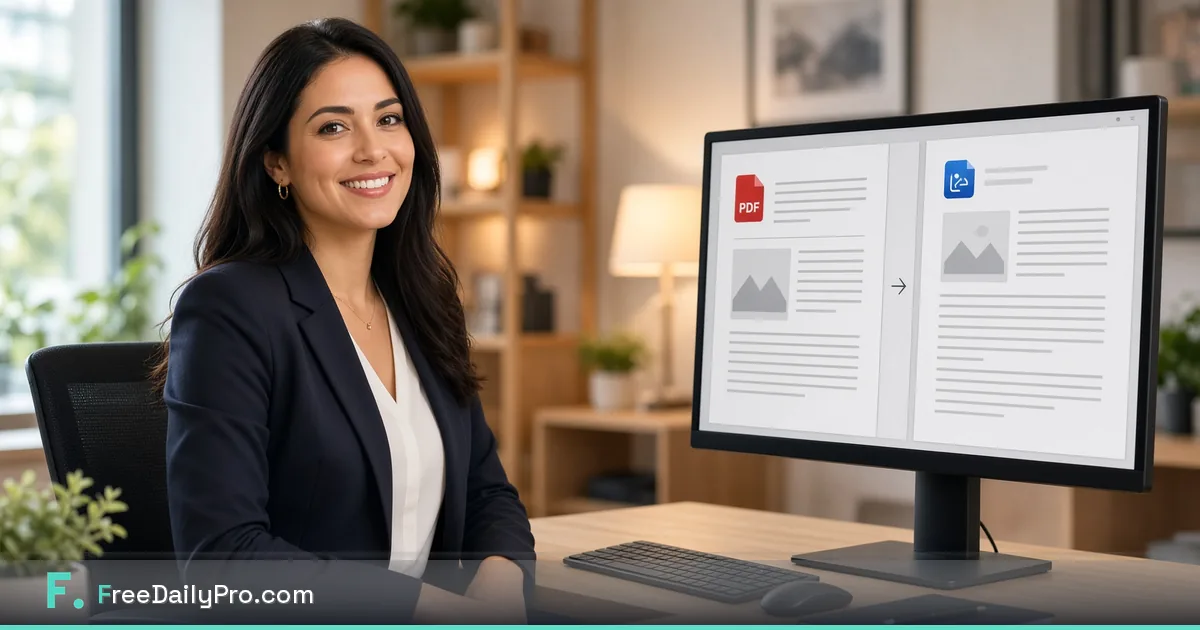
How to Convert PDF to Word Without Losing Formatting (Free)
A practical guide to converting PDF to Word while keeping your layout intact — what works, what doesn't, and why.
If you've ever converted a PDF to Word and opened it to find the paragraphs scrambled, the fonts wrong, or a table turned into a wall of random text, you already know why this is one of the most common file-conversion frustrations there is. PDFs are built to look identical everywhere — they weren't designed to be edited. Converting one back into an editable format means reconstructing something that was deliberately "flattened."
Watch: How to Convert PDF to Word
Watch on YouTubeWhy formatting breaks in the first place
A PDF doesn't actually store paragraphs, headings, or tables the way Word does. It stores instructions like "put this letter at this exact x/y position." A converter has to look at where every letter sits on the page and infer, after the fact, which letters form a word, which words form a line, and which lines form a paragraph or a table row. For simple, single-column documents (a letter, a basic report), that inference is usually reliable. For complex layouts — multi-column pages, tables with merged cells, text wrapped around images — it gets much harder, and that's where formatting most often breaks.
What to expect from a free converter
- Simple text documents (reports, letters, single-column pages): usually convert cleanly, with paragraph breaks preserved.
- Documents with basic tables: often convert reasonably well, though complex or merged-cell tables can shift.
- Multi-column layouts or heavily designed documents (brochures, newsletters): expect to do some manual cleanup afterward — no free tool handles this perfectly.
- Scanned PDFs (images of text, not real text): won't convert into editable text at all unless the tool includes OCR (text recognition).
Before converting, check whether you can select and highlight text in the PDF itself (try Ctrl+A). If you can't, it's a scanned image, and you'll need an OCR-capable tool rather than a standard converter.
A privacy note worth checking, whichever tool you use
Most online PDF-to-Word converters work by uploading your file to their server, converting it there, and sending the result back. That's completely normal, but it does mean your document briefly leaves your device and sits on someone else's server — worth knowing if the file contains anything sensitive (contracts, financial statements, personal records). It's worth checking a tool's privacy policy before uploading anything you wouldn't want stored elsewhere, even briefly.
FreeDailyPro's PDF to Word tool takes a different approach: the conversion happens entirely inside your browser using your device's own processing power. Your file is never uploaded anywhere — not to us, not to anyone. It's free to use (a quick sign-in is required, mainly to keep the service sustainable). For most everyday documents (reports, letters, resumes, simple tables), it handles paragraph structure well and produces a real, editable .docx file.
If your document is more complex
For heavily designed documents — magazines, brochures, anything with multiple columns and precise visual layout — no automated tool, free or paid, will perfectly reconstruct the original design intent. In those cases, the realistic path is: convert to get the text and rough structure, then manually fix layout in Word afterward. That's not a limitation of any one tool; it's the nature of pulling structure back out of a format that was never meant to have it in the first place.